How to Choose Between a Level Transmitter and Level Switch?
Brian Craig
December 26, 2019
Level sensing is an important requirement in industries that utilize different types of fluids for functioning. The increase or decrease in the levels of a fluid may alter the results of the end process, or may also adversely affect people and environment around. To avoid this, industry users rely on various types of level sensing devices such as level switches and level transmitters. These devices help users measure the level of fluids accurately and avoid untoward incidents. Although the aforementioned devices are designed to measure the levels of fluids in various applications, they differ in terms of their operation. What is the difference between a level switch and a level transmitter? How to choose the right device for your application? Read the post to find answers.
Understanding Level Switches and Level Transmitters
What is a Level Switch?
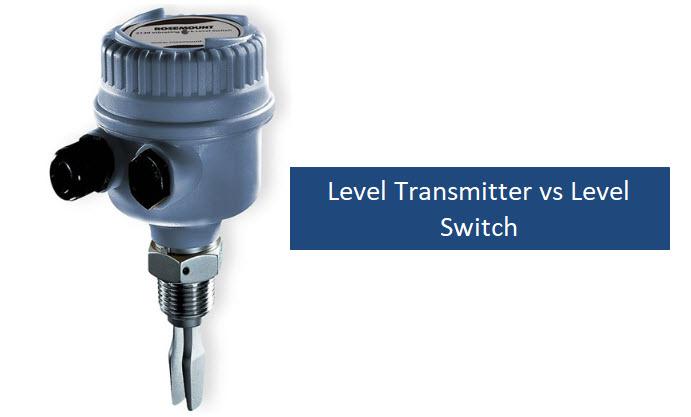
A level switch is a point-level detection device that monitors high or low levels of fluids or solids in a tank or vessel. When the level reaches a preset point, it triggers an alarm or activates equipment (like pumps or valves). These switches are ideal for preventing overflow, dry-run conditions, or low-level alarms in tanks.
What is a Level Transmitter?
A level transmitter is a continuous measurement device that monitors material levels in real-time. It provides a variable output signal, such as 4–20 mA or digital protocols like HART, allowing for precise level control and integration with SCADA or PLC systems. These are preferred in processes that require accurate monitoring of liquid or solid levels over time.

Rosemount 5301 Guided Wave Radar Level Transmitter
Model: 5301

Rosemount 3300 Guided Wave Radar Level Transmitter
Model: 3300

Rosemount 2051L Level Transmitter
Model: 2051L
Working Principle of a Level Switch and a Level Transmitter
The function of a level switch and level transmitter can be understood by their working principle.
- The working principle of a level switch is easy to understand because it works like any alarm switch that turns on/off when the level of fluid goes above or below the predetermined level. When there is variation in the level, the device produces a sound or raises an alarm in some other way. The device works to activate the desired response from a user. The output of a level switch may or may not be voltage-dependent. At times, it may have a voltage-free contact, or sometimes it may have a fixed voltage 0-12 voltage.
- The level transmitter is set with a variable output signal of 4-20 mA. For instance, the level transmitter for a 20-meter high tank will read 20 mA for a full tank, 4 mA for an empty tank, and 10 mA for a half tank. These devices may perform the level measurement in point values or continuously.
Explore Level Switches Available at TTS
The Transmitter Shop supplies VEGA vibrating level switches for reliable point level detection in liquids and bulk solids across industrial process environments.

VEGAWAVE 61 Vibrating Level Switch
Model: VEGAWAVE 61

VEGAWAVE 62 Vibrating Level Switch
Model: VEGAWAVE 62

VEGASWING 63 Vibrating Level Switch
Model: VEGASWING 63
Level Switch Vs Level Transmitter – Important Factors to Consider During Selection
Do you think knowing the level switch and level transmitter working principle is enough to make the right selection? No, you need to understand different aspects related to them. The following factors will help you understand it better:
- Measurement: A level transmitter is perfect for a condition where the exact level of fluid needs to be measured. This is usually preferred for applications where precise measurement becomes a necessity. A level switch is an ideal choice for applications where extreme low or high levels need to be measured. These devices help prevent leaks, overfills, and dry situations.
Level switches and level transmitters are distinguished into two categories point level switches and continuous level transmitters. Some examples of point level switches include optical liquid level switches, horizontal float switches, vertical level switches, and ultrasonic level sensors. Submersible level sensors, ultrasonic level sensors, and capacitive level sensors are a few examples of continuous level sensors.
Understand Environmental Factors: The choice of a level transmitter or a level switch will depend on various environmental factors such as:
- Pressure and temperature: Effects of temperature and pressure on transmitters or level switches may vary if the material undergoes a transition from one state to another. These devices are available in different materials and designs. So, you need to understand the temperature and pressure impact on a particular material, before selecting them for your application.
- Range of measurement: Continuous level transmitters are used for level sensing dry or liquid materials within a specified range. They measure over a large range of levels which helps the user understand the right amount of substance. Most continuous level transmitters produce an analog output to indicate the level of fluid in the container. Against this, level switches are suited for point measurements.
- Type of output: Level switches and transmitters are suited for producing different types of outputs – relay, analog, and digital.
- Chemical compatibility: These level sensing devices may be used with a variety of liquid media. At times, the housing of the transmitter may come in contact with the media, which may affect its integrity. It is important to address the concern of the impact of different chemical media on sensors.
- Tank size and shape: The choice of level sensing device may also depend on the tank size and shape. Extra narrow or wide tanks may have specific requirements.
A fair consideration of these factors will aid you in making the right selection. Even if you have an understanding and knowledge of these factors and your application requirements, it is still recommended to partner with a trusted supplier like The Transmitter Shop. The company provides various types of new and reconditioned transmitters.
Level Transmitter vs Level Switch: Quick Comparison
The following table summarises the key differences between a level transmitter and a level switch to help you identify the right instrument for your application at a glance.
| Factor | Level Transmitter | Level Switch |
|---|---|---|
| Measurement Type | Continuous measures level across full tank range | Point detects level at one specific point only |
| Output Signal | Variable 4-20 mA, HART, digital protocol | Discrete on/off relay or transistor output |
| Primary Use | Process control, inventory monitoring, SCADA/PLC integration | Overfill protection, dry-run prevention, high/low alarms |
| Accuracy | High provides exact level reading at all times | Not applicable triggers only at set point |
| Installation Complexity | Moderate requires calibration and signal wiring | Simple minimal setup, no calibration required |
| Cost | Higher | Lower |
| Moving Parts | None (radar, ultrasonic, DP types) | None (vibrating fork, capacitive types) |
| Best Technology Examples | Guided wave radar, radar, ultrasonic, DP transmitter | Vibrating fork, capacitive, float switch |
| Used Together? | Yes transmitter for control, switch for safety backup | Yes switch for alarm, transmitter for monitoring |
Level Transmitter or Level Switch: Making the Right Selection
The decision between a level transmitter and a level switch comes down to what the process actually requires from the instrument.
Use a Level Transmitter
- The process requires continuous real-time level monitoring across the full range of the tank or vessel
- The level reading needs to be integrated into a PLC, DCS, or SCADA system for automated process control
- Inventory management or custody transfer requires an accurate, traceable level measurement at all times
- The application involves tight level control loops where the control valve or pump speed must respond proportionally to the level
- Multiple level values across the tank range are needed for reporting, trending, or alarm management
Use a Level Switch
- The application only requires detection of a single high or low level point not a continuous reading
- The primary requirement is overfill protection, dry-run prevention, or a simple high or low level alarm
- A cost-effective, low-maintenance solution is needed for a non-critical level detection application
- The switch will act as a safety backup alongside an existing level transmitter in a critical vessel
- The installation requires a simple relay output to activate a pump, valve, or alarm without PLC integration
In many industrial applications, both instruments are used together a level transmitter for continuous process control and a level switch as an independent safety device for high or low level alarm activation.
Frequently Asked Questions (FAQ):
What is a level transmitter?
A level transmitter is a device that continuously measures and monitors the level of liquids or solids in a tank or vessel, providing real-time output for process control.
What is the difference between a level switch and a level transmitter?
A level switch provides on/off status at a specific level, while a level transmitter provides continuous, analog or digital level measurement across the full tank height.
What is the difference between a level switch and a flow switch?
A level switch detects fluid level at a specific height in a container, whereas a flow switch detects whether a fluid is moving through a pipe or not.
Which industries commonly use level transmitters and switches?
Industries like chemical processing, oil & gas, water treatment, pharmaceuticals, food & beverage, and power generation rely on both level transmitters and level switches for accurate and reliable fluid control.
Can level transmitters and switches be used together?
Yes, many systems use both transmitters for monitoring and control, and switches for safety alarms or backup alerts.
Related Posts
- What are the Advantages of Different Types of Level Measurement Transmitters?
- Types of Level Measurement Transmitters & How Do They Work?
- How to Choose Between a Level Transmitter and Level Switch?
- Radar Level Transmitters: Setup and Working Principle
- Radar Level Transmitters: Types, Working Principle & Industrial Applications
- Radar Level Transmitter Vs Ultrasonic Level Transmitter – Know the Real Difference
- Know How Guided Wave Radar Level Transmitters Work
- Level Monitoring Solutions for Molten Metal Applications
- Industrial Instruments in Nuclear Power Plant Safety